Simone Ciglia is an Instructor at University of Oregon and a freelance curator. He’s also written works for Flash Art Magazine, and other publications like Treccani and Zanichelli. His primary focuses are contemporary art, especially how it connects to agriculture, design, and utopian or dystopian ideas.
He has also taught at the Academy of Fine Arts in Urbino, Italy, and worked as an Assistant Researcher at Rome’s MAXXI – National Museum of XXI Century Arts. He completed his Ph.D. in the History of Contemporary Art at “Sapienza” University of Rome.
*Information via the University of Oregon College of Design Website
In an art history course I had taken this term; I learned about the history of design between the post World War II period and today. In the course taught by Doctor Simone Ciglia, we learned about the history of graphic design and how it dipped into art and advertising. Something that I found interesting, was how art was used in advertising to appeal to public desires; money, control, success, stability, class, etc. This made me think about the state of our world today; how things like digital media, the impact of influencers, etc, all help to promote material goods that appeal to the desires of the public.
Given my interest and pursuit in fashion design, I applied this concept to the industry as a whole, reflecting on the various ways clothing has been designed and promoted as to fix a sort of “issue” or insecurity on may have. I began to wonder– can art and fashion exist without the consumer’s need to fulfill a desire?
I reached out to my professor to seek more of his knowledge and background on this subject. If I want to make a difference in the industry, I must start from the ground up.
Doctor Ciglia and I began talking about this concept, but my primary focus of the interview was to hear about innovative ways he’s seen artists communicate, and to gauge if he believed it could be possible to create something, from an artists’ perspective, without the means to fulfill ones desire.
I asked Ciglia to recount any specific ways he’s seen artists communicate (whether it be the artist’s incentive, values, overall message, perspective, etc). He responded by explaining the concept of an experiential turn. He explains it as “an idea of involving the spectator on an experiential level.” Further, how this steers away from the spectator’s ability to simply just observe a piece of artwork– “like a painting on a wall,” he says. Rather, it fully involves the spectator by triggering other senses.
He explained how this was a strategy that developed since the 1960’s, with the idea of exploding artwork into the physical environment. Furthermore, discovering how art could expand beyond just a material object– so the “art work is not simply just an object”.
This information was valuable to me, as it was a connection I had previously made after reading “Art and the Senses” which I wrote about in this blog post.
We went on to discuss the intersections yet vast differences between art and design, and the impacts of consumerist desires on an artist’s intentions. But one of the greatest takeaways from this interview, is the ideas I have for my own creative journey from whaat he explained about the process of experiential art. I had always been inspired by the senses and wanted to learn more about how they impact our perception of artistic works, but now I feel inclined to move forward; putting my interest to practice.
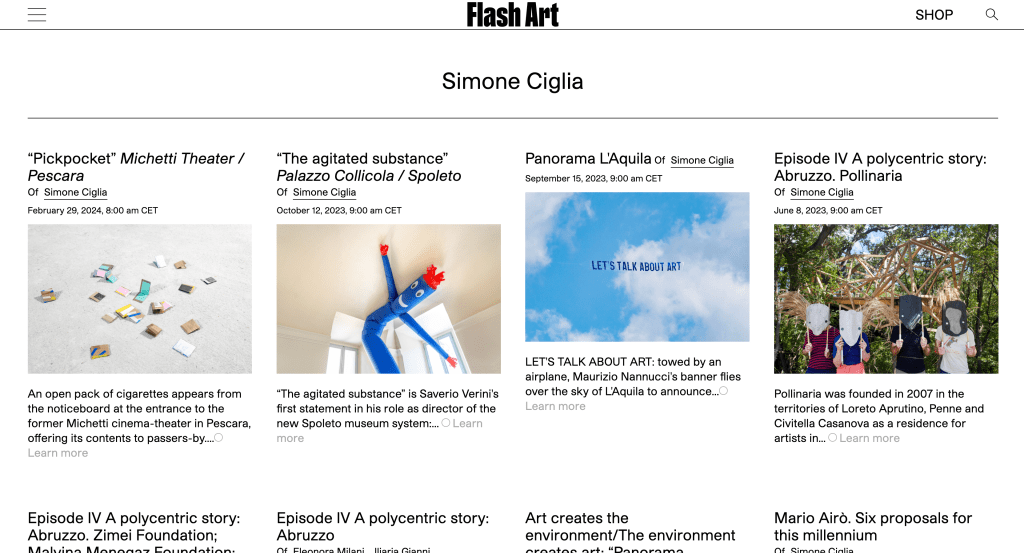
Read some of Simone Ciglia’s publications for Flash Art Magazine, here

 Jade Anaya
Leave a comment